
01
The two Outbacks worth knowing
Most of the Outbacks on Kent roads fall into one of two groups, and they are quite different cars.
The earlier generation, sold here from 2015, came with a 2.5 litre petrol engine and, until it was withdrawn in 2018, a 2.0 litre boxer diesel. That diesel is the one that gets tuned most often, and it is the reason many owners ring.
The current car arrived in 2021 with a single powertrain: a 2.5 litre petrol engine, a continuously variable automatic and permanent four wheel drive. No diesel, and no manual. It is a smoother, quieter car, and there is less for software to do on it.
The petrol Outback itself is no longer on sale new in Britain. Subaru has moved the name to an electric model, so the cars we see are the ones already on the road. That is fine by us, because they stay on the road for a long time.
02
The diesel estate, and why it suits a tune
A turbocharged diesel in a heavy estate is a good candidate for calibration work, for a straightforward reason: there is boost to manage and a torque curve to shape.
Owners describe the standard car as unhurried. It will get there, but it wants to think about it first, and with a caravan on the back that thinking time becomes a frustration on the A20.
A map written around towing and load changes that. The engine holds its pull lower down and the gearbox stops hunting between ratios on a gentle incline. It does not make the car fast. It makes it relaxed, which is what an Outback owner actually wants.
03
The petrol car, where we are careful
The 2.5 petrol in the current car is naturally aspirated, so there is no turbo to adjust and no boost target to move.
We can tidy the throttle mapping and look at how the transmission is asked to behave. That is a small change and we describe it as a small change. Anyone promising a transformation on a naturally aspirated Outback is selling you something that does not exist.
The earlier 2.5 petrol cars are the same story. Where owners want more, our honest advice is usually about tyres, servicing and weight rather than software.
04
Caravan, trailer, and the weight behind you
This is the heart of the Outback conversation, and it deserves its own section.
A big estate towing a caravan on a Kent A road is a study in compromises. The car is stable, but the engine and gearbox have to work with a lot of mass behind them, and the standard map is written for a car on its own.
A calibration for towing is not about more speed. It is about the car doing the same job with less effort, holding a gear where the engine is comfortable, and giving the driver a bit more confidence when joining a dual carriageway with a trailer.
We will not quote you a towing figure. The right answer depends on the trailer, the load and how you drive, and the towing remap page covers the reasoning properly.
05
Before any file is written
Every Outback gets dealer level diagnostics first, whatever the engine.
On the diesel cars that means a hard look at the particulate filter and the recirculation system, because a diesel estate used for short trips will have a soot problem before it has anything else. We read live data under load, check boost pressure against demand, and measure what the filter is actually doing.
On the petrol cars we check the ignition system, the fuelling and the transmission behaviour.
If something needs repairing, the repair happens first and the map waits. A clogged filter is a repair. So is a split boost hose. Neither is fixed by a calibration, and we will not pretend otherwise.
06
The transmission, when you are loaded
The diesel Outback could be had with a manual or an automatic. The current petrol car is automatic only.
On the automatic cars, the transmission has its own control software and how it is asked to behave matters a lot when you are loaded. The gearbox tuning page goes into what is and is not possible there. On the manual cars, the driver is the gearbox, and a calibration that gives more pull at low speed is felt most.
07
Ring us about your Outback
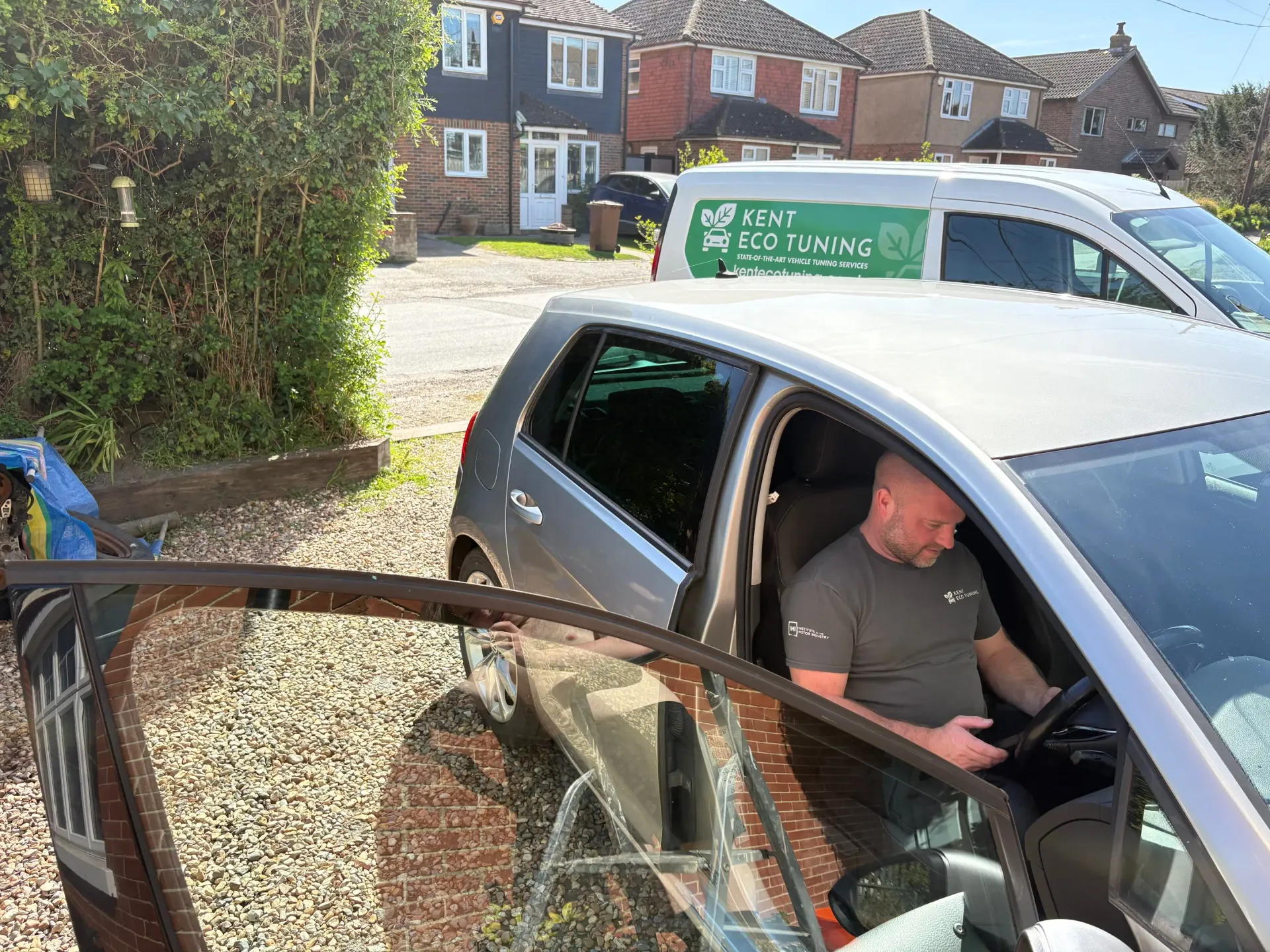
We come to you, fully insured, and the car stays on your drive while most Outback work goes through the diagnostic port in a few hours. Ashford, Maidstone, Sittingbourne, the Medway towns, the M20 corridor and the Weald villages are all normal for us, and Essex across the crossing is a straightforward trip. The car never has to move, and no workshop visit is involved. Call 07946 854971 with the registration and tell us what you tow and how often. The Subaru brand page lists the other models we cover, and the ECU remapping overview explains what the work involves from start to finish. If you would rather write it down, the contact form on this site reaches us just as quickly.
08
Outback questions
09
Is the diesel Outback the one to tune?
It is the one with the most scope, yes. The petrol cars are smoother and have less for software to change.
10
Can you map a 2021 onwards petrol Outback?
We can look at it, but we will be honest about the small scope before you book. Coverage is confirmed from the registration.
11
Do you see many Outbacks with filter problems?
We do, particularly on cars used for short journeys. Those are diagnosed, not mapped around.
12
Can you work with a caravan hitched?
Better to unhitch before the diagnostic and the calibration. We will tell you what we need on the day.
13
Related models
Owners often compare this with Subaru BRZ, Subaru Forester and Subaru WRX, and each has its own page covering the engines and what the calibration changes.