01 The Science of Precision Calibration
A remap is the careful revision of the software that governs how your Custom's engine runs. We read the existing map from the ECU, then adjust the parameters that shape everyday driving: fuel delivery, turbo boost, and the torque limiters that decide how willingly the engine answers your right foot from low revs. Every change stays within the safe operating limits the engine was designed around, which is why a well-judged calibration feels like a better version of the same van rather than a different vehicle.
The distinction that matters on a Custom is between a generic file and a custom calibration. An off-the-shelf map is written for an average van in average use — it cannot know whether your Custom spends its life nose-in to a skip-laden street in Chatham, idling through Rochester High Street traffic, or cruising at a steady pace with a full load of fixings in the back. A custom calibration takes account of how the van is actually used: the weight it carries, the journeys it makes, and what the driver wants from it. For the Custom, that usually means one thing above all — pull from low revs, where a loaded van needs it. You can read more about our approach to ECU remapping in Kent on the main service page.
02 Model Coverage
The Custom has been through several engine generations, and each one is its own calibration exercise.
Earlier vans run the 2.2 TDCi Duratorq diesel, a straightforward, hard-working engine that many Kent tradespeople still run daily. It responds well to a calibration that tidies the mid-range and makes the engine more eager below the revs you use in traffic. Later vans moved to the 2.0 TDCi and then the 2.0 EcoBlue, which brought a more modern injection system, a DPF, and — on many examples — an automatic gearbox option. These engines reward a more refined calibration that smooths the power delivery and improves how the van pulls away when loaded.
Body styles matter too. A low-roof SWB used as a courier's van is calibrated with a different priority from a high-roof LWB carrying a full fit-out of tools and materials, and the limited models that haul trailers or mini diggers have their own needs. We ask about the load, the routes and the driver before we write anything.
03 High Power & Ultimate Performance Tuning
For the Custom, "performance" rarely means anything exotic. It means the van pulling cleanly away from a site entrance with a full load aboard, holding speed up a long climb without hunting for gears, and feeling noticeably less strained at the end of a day of A-road and town driving. A performance-orientated calibration for a Custom reshapes the torque curve so the effort is delivered lower down, where a working van spends its life, and sharpens throttle response so the van feels more alert in stop-start traffic.
If your work involves towing — plant trailers, mini diggers, scaffolding — the calibration can be weighted for it. An engine asked to haul a heavy trailer does its best work when the torque arrives early and progressively, not in a rush at the top end. That is a deliberate choice we make with you before the file is written, because towing priorities and town-economy priorities do not always point the same way.
04 Maximum Efficiency & Economy Remapping
Fuel is one of the largest running costs a trade van has, and it is the part a remap can genuinely influence. An economy-focused calibration reshapes how the engine delivers its effort so the same work is done with less fuel burned: smoother torque low down means less foot down, fewer wasted revs in town queues, and a van that cruises rather than struggles.
The honest position is this: results depend on the van's mechanical condition, the load it carries, the routes it drives and the way it is driven. A Custom doing short town rounds between Chatham and Gillingham will respond differently from one running daily motorway legs to Maidstone or Canterbury. What we can promise is a calibration matched to your actual duty cycle — and for businesses running several Customs, our van and fleet remapping service is built around exactly that conversation, van by van.
05 Specialist Software Solutions: DPF, AdBlue and EGR
The later EcoBlue Customs live with a diesel particulate filter, an AdBlue system and an EGR valve, and each of them can throw a fault that stops a working van. DPF warning lights, AdBlue countdown warnings and EGR-related running problems are among the most common issues we see on this model in Kent, particularly on vans that do a lot of short, low-speed journeys.
A physically blocked DPF requires repair rather than a software change, and removing or defeating emissions equipment can cause an MOT failure. We will never advise removing, deleting or defeating these systems. What we do is diagnose properly, provide lawful software solutions where they are genuinely appropriate, and give clear, honest advice when they are not. If a DPF problem is being caused by a duty cycle that never lets the filter regenerate properly, we will tell you that too — because it changes what the right answer is, and it may not be a software answer at all.
If your Custom has a DPF, AdBlue or EGR warning showing, get it looked at before it becomes a limp-mode situation on a job. See our pages on DPF software solutions in Kent and EGR solutions in Kent for how we approach these faults.
06 Transmission Tuning: the Six-Speed Manual and Ford's Automatic
Most Transit Customs on Kent's roads run the six-speed manual gearbox, and later vans are commonly ordered with Ford's automatic transmission. Both benefit from attention to how engine torque is delivered through the drivetrain.
On a manual Custom, the calibration work is mostly about the engine side — how smoothly torque builds, how the van takes up drive from rest when loaded, and how it behaves changing up under a working load. Where the van carries the automatic, and where the transmission control software allows calibration, we can refine shift behaviour and torque management during changes, which is most noticeable pulling away heavily loaded or working a trailer. Combined with an engine calibration, a well-sorted gearbox is the difference between a van that feels refined and one that feels like it is fighting itself. Our gearbox and transmission tuning page explains the options in more detail.
07 Why Choose Kent Eco Tuning for Your Ford Transit Custom?
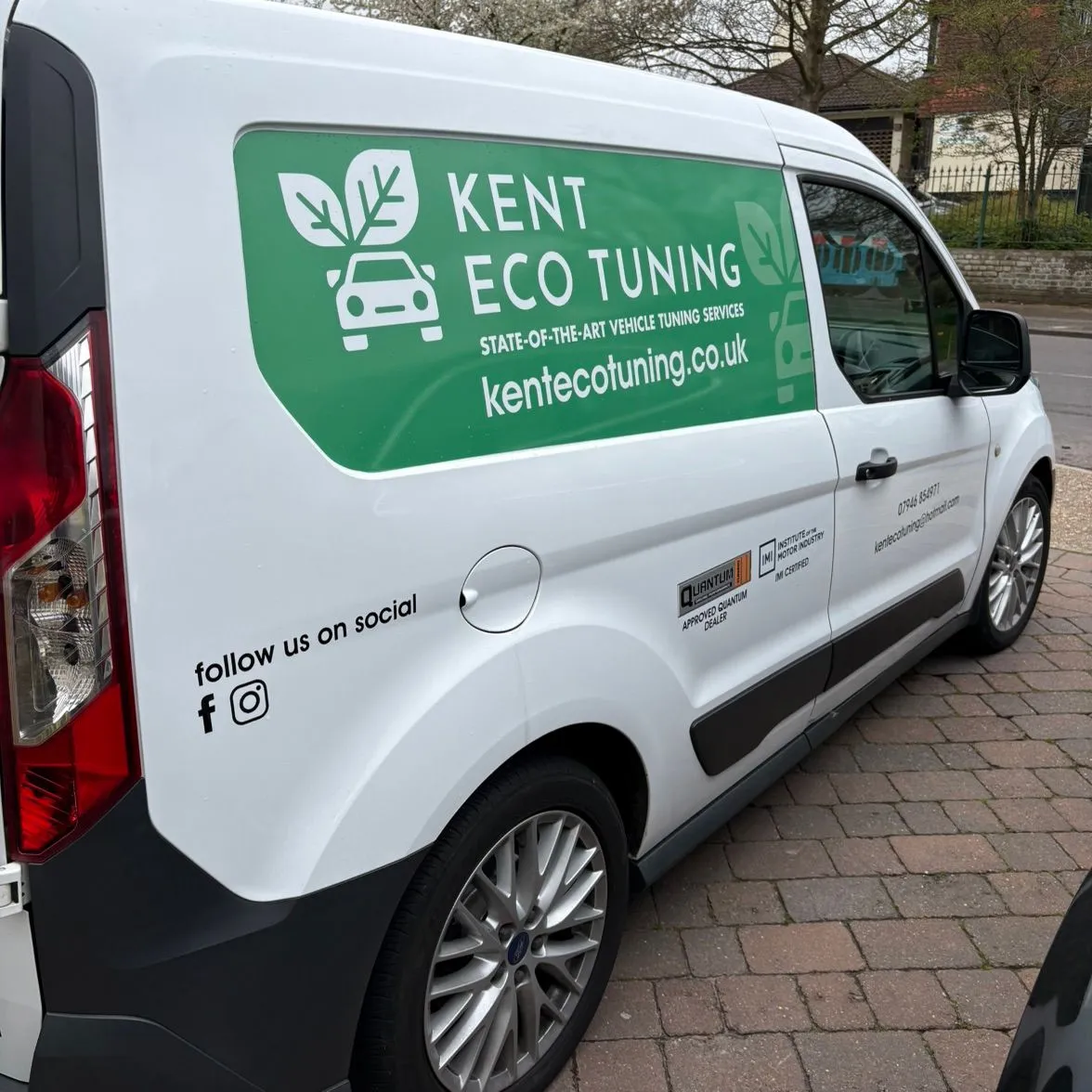
Kent Eco Tuning is a local, independent tuning specialist based in Medway and working across Kent and Essex — Chatham, Gillingham, Rochester, Strood, Rainham, Sittingbourne, Maidstone, Gravesend, Faversham, Dartford, West Malling and the surrounding towns. We are IMI-certified and fully insured, and we give straightforward advice even when the honest answer is that a remap is not what your van needs.
The part that matters most for a Custom owner is that we come to you. Our mobile service carries out the work at your yard, your home or your workplace, at a time that fits around your jobs, so the van never loses a working day being dropped off and collected. One van or a small fleet of Customs on a programme of renewals, the same principle applies: less disruption, more earning.
Kent Eco Tuning is an independent specialist and is not affiliated with, endorsed by or connected to Ford Motor Company in any way.
08 Book Your Transit Custom Remap
If your Custom feels flat when loaded, costs more in fuel than it should, or is showing an emissions-related warning light, a conversation costs nothing. Call 07946 854971 to talk through your van and what a calibration could do for it, or send the details through the contact form and we will get back to you.
Kent Eco Tuning — www.kentecotuning.co.uk — 07946 854971