
01
Supercharged cars ask for something different
A supercharger is driven by a belt, so its boost follows engine speed and stays predictable. That linear delivery is exactly why owners of early R53 cars become attached to them. It is also why a calibration for a supercharged engine cannot simply be copied from a turbo file.
The engine pulls from low down with no waiting for boost to arrive. What a tune changes is the relationship between the pedal and the work being done. Owners tend to notice it on a rolling start, on a slip road, or when pulling out of a busy junction on a wet morning.
Cars of that age have usually covered a fair distance. Belt condition, pulley wear and the state of the intake all get a look before a line is written. There is little sense in asking an engine to work harder if the hardware feeding it is tired.
02
Turbos, heat and a modern file
The F56 changed the character completely. A turbocharger brings boost in once the exhaust gas carries enough energy to spin it, so the delivery feels like a push through the middle rather than a steady surge from idle.
That shape suits a calibration well, because there is a broad band where the engine can be given more authority without straining anything. The JCW starts from a stronger base, so the priorities shift. On those cars the question is often how the power arrives rather than how much of it there is.
Heat deserves respect on any turbo car. A file that ignores intake temperature, or asks for boost in conditions the intercooler cannot handle, is a poor file however lively it feels on one cold morning.
03
What gets read before the map is touched
Fault memory comes first, across every module rather than the engine alone. Then the engine runs while we watch the numbers that matter on a forced induction car: how much air is being asked for, how much arrives, and how much timing the ECU is willing to give.
Typical findings on a Cooper S include a tired boost control valve, a split hose, a weeping rocker cover gasket and a carboned intake on the direct injection cars. None of those are tuning faults and none of them improve with software. Where something needs attention we say so, and the work waits until it is sorted. Our page on diagnostic health checks sets out what is covered.
If the car already carries a map from elsewhere, we read it first and assess it. A poor previous file is a reason to begin from a known base rather than to layer a second calibration on top of it.
04
What the visit looks like
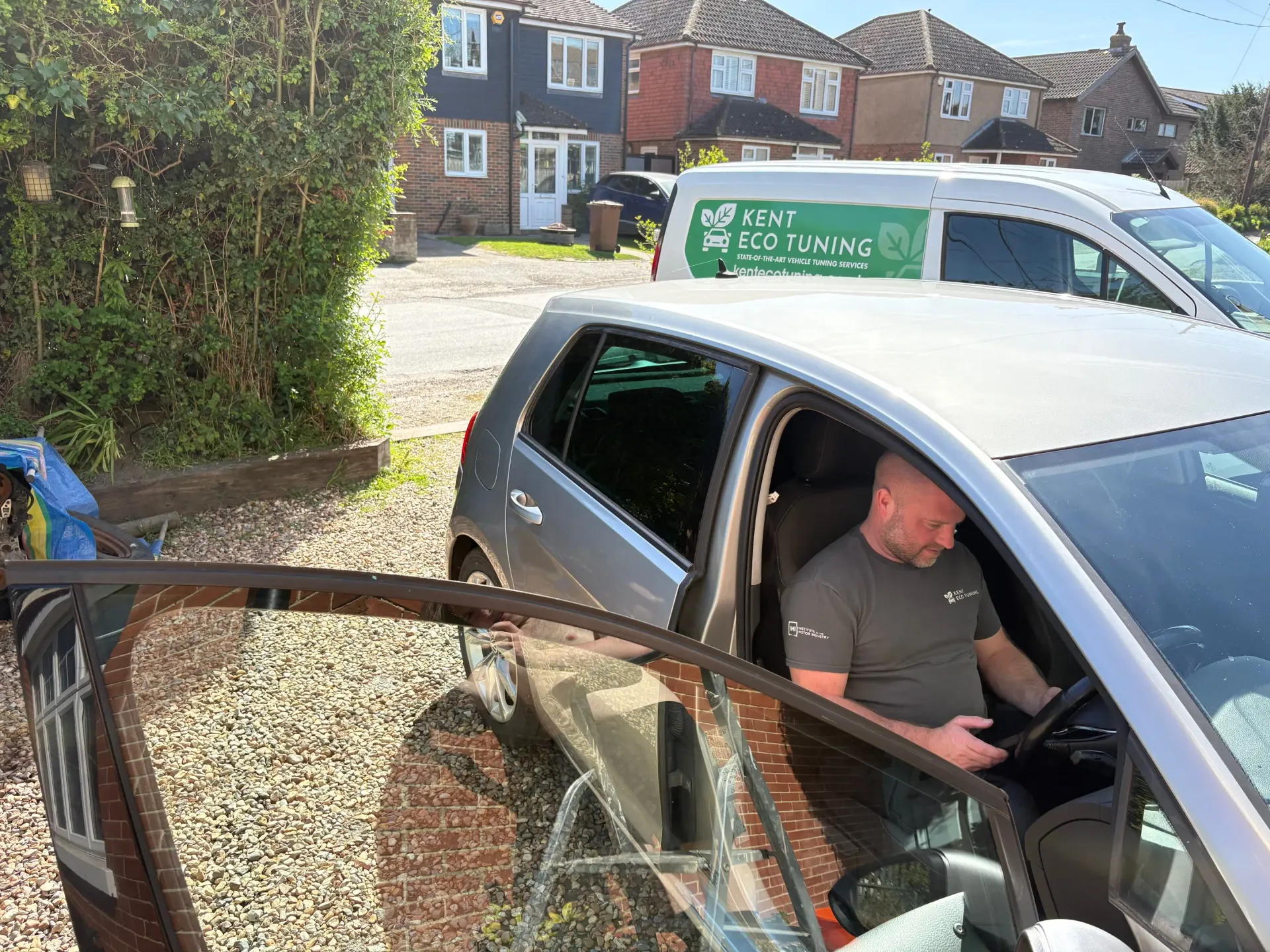
The work happens where the car is parked, whatever the address happens to be. There is no workshop to visit and no drop-off to arrange, because the service is mobile by design.
Reading the original software takes a short while. The file is then prepared around the answers you gave about how the car is used, and the calibration goes back in once the health check has cleared. A road test follows, then a second look at live data to confirm the car is behaving as it should.
Manual and automatic cars are both fine. Cooper S cars left the factory with more than one transmission across the years, so what suits yours depends on which one is fitted, and the registration answers that quickly.
05
Short journeys and long ones
Most Cooper S cars in Kent do a bit of both. A weekday run into Medway and back, then something more interesting at the weekend. That mixture is fine, but it shapes what we recommend.
A car that rarely gets warm will hold moisture in the oil and soot in the intake. It also gives the ECU a narrow set of conditions to learn from. If that is your week, say so, because a file written for a motorway commute is not the same as one for a five mile school run with the engine never reaching temperature.
Owners who mostly do short trips often find the biggest change in the first mile rather than at speed, because that is where the standard calibration feels most reluctant.
06
Power, economy or somewhere between
Many Cooper S owners want the sharper end: quicker response, stronger pull through the middle, easier overtakes on a B road. Others commute and would rather have a car that sits calmly at motorway speed and uses less fuel when driven sensibly.
Both are legitimate, and the file reflects the choice you make. The trade off is spelled out on our power versus economy page. Automatic owners chasing cleaner shifts will find gearbox work described separately.
07
Arranging a visit
Ring 07946 854971, or put the registration into the contact form along with a line about your commute. We will tell you honestly what your car needs before you commit to anything. The wider model range is gathered at MINI remapping Kent. Anyone wondering whether a standard car can take this safely should read our safety explainer.
08
Cooper S tuning questions
09
Does the JCW need a different approach?
Yes, though not for the reason most people expect. The hardware is stronger, so a file can be built with a little more room. The bigger factor is still how the owner drives it.
10
Can a supercharged engine still be tuned?
It can. Belt driven boost responds well to a carefully written calibration, provided the belt, pulley and intake are in good order first.
11
Will a tune make the car louder?
No. Sound is a hardware matter. The exhaust note does not change because software was rewritten.
12
What about an automatic car?
Automatic cars are fine. Whether the gearbox wants its own attention depends on which unit the car has, and the registration tells us that.
13
Related models
Owners often compare this with MINI Cooper, and each has its own page covering the engines and what the calibration changes.