
01
Why the body changes the brief
A four door coupe carries a little more weight than the hatchback it shares its foundations with, and that weight sits in a slightly different place. The engine has the same appetite for work, but the way the car uses what it produces feels different from behind the wheel.
Owners of the C117 mention the way the car covers ground on a fast A road. It has a longer stride than the hatch and rewards a driver who rolls onto the throttle early rather than stabbing at it.
That is precisely where a calibration earns its place. A file written for this body can fill the small hole in the mid range where the standard car gathers itself, so the car pulls cleanly through the middle instead of waiting for the top end to arrive.
The C118 sharpened the chassis and brought the newer engine, and its character is tidier rather than wilder. Both respond, but for slightly different reasons.
02
Two engines, two sets of limits
The M133 is the older of the pair and the one most people know. It builds boost briskly and has a voice of its own, and a file that respects the way it spools will feel natural rather than forced.
The M139 in the C118 runs far higher boost from the factory. There is less unused capacity, and everything that feeds the engine has to be in good shape before a calibration makes sense. This is not a car where you write first and inspect later.
Whether the car left the factory with more than one transmission option across the generations is a question we settle from the registration. The gearbox fitted decides part of how the work is planned, and guessing is a route to a poor result.
03
The inspection that comes first
Anything running high boost gets looked at closely, and the CLA 45 is no exception. Charge pipes get looked at where the joints sit and along the rubber where it ages. The intercooler and its connections get checked properly rather than eyeballed.
Intake deposits are assessed, because the direct injection design means carbon builds on the valves over time and dulls the response in a way that no fault code reports. The turbocharger gets a physical look, with the wastegate and the shaft checked rather than assumed.
A previous map is common on these cars, and so is a tuning box that the owner may have forgotten is fitted. Either has to be identified before new software goes anywhere near the ECU, and a box has to come out rather than stay in place. Unknown software underneath a new file is the shortest path to a large bill.
The rest is standard work. Fault memory read across every module, fluids checked, and a road run with the laptop recording what the engine does under load.
04
What the visit looks like
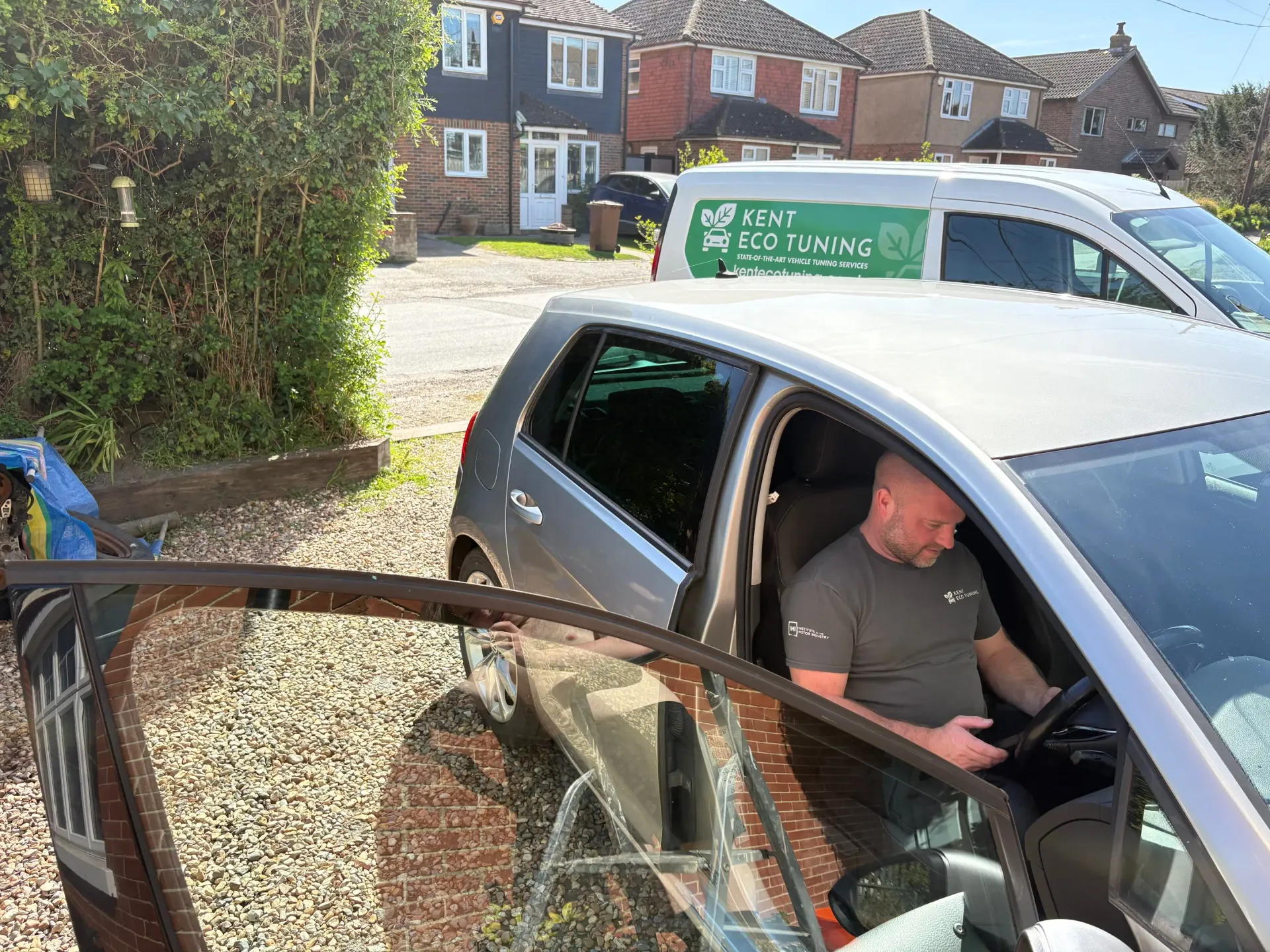
The car is worked on where it is parked. There is nothing to bring anywhere and no appointment at a premises, because there are no premises to visit.
Questions come first and they are not a formality. Whether the car does a daily motorway run to London or a five mile hop to a station determines what the file should do. So does the fuel you buy and whether you ever tow.
The original software is read and saved. The calibration is prepared and written, and then the car goes back out onto the same roads for a second set of logs.
Comparing the before and after is how we know the car is behaving. Where the logged figures and the drive home tell different stories, we keep looking.
05
Picking the character you want
Three directions are available and the choice belongs to the customer. Power sharpens the response and strengthens the pull through the middle. Economy suits the owner who spends most of the week at a steady speed on the M2 or the M20.
Towing torque sits between them, and it is not a niche choice for this model. Cars like these carry bikes, trailers and loaded roof boxes, and a file written for that weight behaves very differently from one written for a solo car.
The three directions are compared in more detail under power versus economy. Anyone with an automatic transmission who wants faster, cleaner changes should read the separate gearbox tuning information.
06
Knowing whether to go ahead
A CLA 45 with proper history and sound hardware takes this work in its stride. One with a weeping turbo, tired charge pipes or a mystery file from an unknown source is a different job, and it may be a repair job before it is a tuning job.
That decision is not made for you. Findings are explained, the implications are set out plainly, and the choice stays with the owner. There is no pressure applied in either direction.
Insurance should be told, and the work itself is carried out under full insurance by an IMI certified technician.
07
Booking the car in
Give us a ring on 07946 854971 or send the registration through the contact form. A sentence on how you use the car helps more than you would expect. Broader coverage sits at Mercedes remapping Kent, and anyone wondering whether a modified car is still safe should read the safety explainer.
08
CLA 45 tuning questions
09
Is the C118 harder to tune than the C117?
It is tighter rather than harder. The M139 runs more boost from the factory, so the inspection matters more and the file is written with less room to play with.
10
Can you tell if my car already has a map on it?
Usually, yes. The reading tells us what is there, and a file that differs from the manufacturer's own is a file we need to understand before replacing it.
11
Does a tune change the exhaust note?
It does not. Sound comes from hardware, so the note stays as it is unless the exhaust itself has been changed.
12
Will it affect my warranty or insurance?
Insurance should be informed of any modification, which is standard practice. On warranty, the manufacturer's terms apply and it is worth reading them before booking.
13
Related models
Owners often compare this with Mercedes-Benz A35, Mercedes-Benz A45 and Mercedes-AMG GT, and each has its own page covering the engines and what the calibration changes.