
01
The N and the standard car are not the same job
The N runs a 1.6 T-GDi with a turbo sized for response rather than for headline output. The standard i20 runs a 1.0 T-GDi three cylinder, which is a completely different engine with a completely different character.
Owners of the 1.0 often come to us after a year of commuting, having decided the car is fine everywhere except on a hill with four people in it. A calibration helps most in the mid range, where the small engine is doing its work.
On the N, the questions are different. Owners want the car to feel more alive in the first two gears, and to hold its pull past the point where the standard software starts to soften.
02
Small turbos and why we stay sensible
A small turbocharger spins up quickly, which is why the N feels eager at low speed. It also has a limited comfortable operating range, because it is pushing air into a small engine with a modest intercooler.
Asking a small turbo for more than it can sustain gives a car that feels brilliant on one cold morning and flat the next week when the weather warms up. We would rather write a calibration that holds its performance in July than one that only works in February.
That means a conservative approach on the N, working within what the hardware can carry rather than chasing a figure for a webpage. It is the honest way to tune a car this size.
03
Things we check on the N before writing anything
Hot hatches get driven hard, and a used one may have had a previous life. Fault memory across all modules comes first, then a logged road run shows whether the turbo actuator is moving cleanly through its range.
Then a look at the boost pipework and intercooler hoses for splits or loose clips, the condition of the intake, the oil level and the service record. Clutch slip gets mentioned by owners of tuned examples, and we would rather hear about it than discover it on a road test.
Where a car arrives with software already on it, that file gets judged on its merits. A poor earlier calibration argues for putting the factory file back rather than layering a second one over it. Cars bought used sometimes arrive with software nobody told the new owner about, which is worth knowing.
Where a fault or a worn part turns up, we say so and nothing gets written until it is sorted. Our diagnostics page explains what the visit involves.
04
How the visit runs
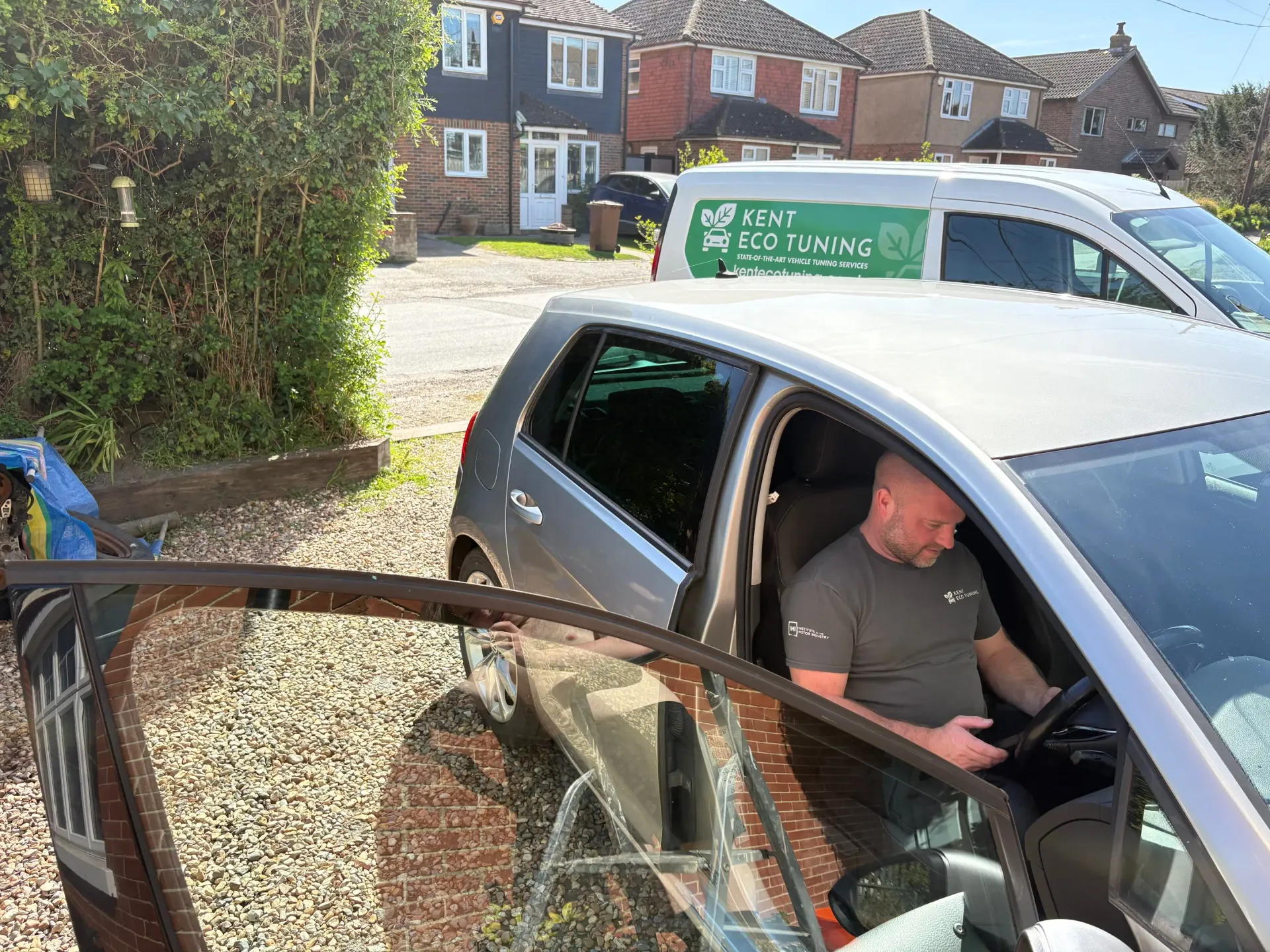
The car stays on your drive. We travel to it, whether that is a street in Gillingham, a house in Sittingbourne, a work car park in Maidstone or somewhere out towards Tunbridge Wells.
Whatever is on the car when we arrive gets copied off and stored first. The calibration follows, built around how you actually use the car: a daily commute, weekend B road drives, the occasional track day, or a mix. Then it goes back in, we road test, and the readings get checked a second time.
Nothing is collected and nothing is taken away. There is no workshop in the picture at all, because the service comes to you.
05
What the N owner usually asks for
Sharper throttle response is the most common request, because the standard pedal map is gentle in the first part of its travel. Stronger mid range pull is next, which shows up as easier overtakes and less gear shuffling on a fast A road.
A few owners ask about economy, usually because the car doubles as a commuter. That calls for a separate calibration entirely, and our power versus economy page sets out what alters. Track day drivers may also want to read about gearbox behaviour if they find the shifts hurried under load.
06
Warranty, insurance and the boring paperwork
Two questions come up on almost every call about a new or nearly new N, and neither is about software.
The first is the manufacturer warranty. A calibration is a modification, and how a dealer responds to one is their decision rather than ours. Plenty of owners wait until the cover ends, and that is a reasonable choice for a car this new.
The second is insurance. Any change to the software should be declared, because an undeclared modification can leave a policy doing very little when it is needed. We will say that plainly, and then leave the decision where it belongs.
07
Book a visit
Ring 07946 854971 when convenient, or put the registration through the contact form with one sentence about how the car is used. Other Hyundai models are gathered at Hyundai remapping Kent. The larger i30 N has a page of its own for anyone comparing.
08
i20 N tuning questions
09
Can the standard 1.0 i20 be tuned too?
Yes, and it is a different job entirely. The three cylinder engine responds best to mid range work rather than to a hot hatch calibration.
10
Is a conservative file a weak file?
No. It is a file written for the hardware that is actually on the car. Ours holds up in warm weather rather than only on a cold morning.
11
Will my warranty be affected?
That is a question for your dealer, and we would not pretend to answer it for them. Many owners wait until the warranty period ends.
12
Does the gearbox need anything?
Usually not. What was fitted varies between cars and years, so we confirm the transmission from the registration rather than assuming, and the engine file is written around it.
13
Related models
Owners often compare this with Hyundai i20, Hyundai i30 and Hyundai Kona, and each has its own page covering the engines and what the calibration changes.