
01
High-Mileage Car Remap: Condition Comes First
A car's odometer records distance travelled, not how well the vehicle has been maintained. A car with higher mileage and a consistent service history may be in better condition than a lower-mileage vehicle that has missed maintenance or has spent years making short journeys.
That is why a remap should be based on the vehicle's condition, not a mileage cut-off. The engine, turbo, fuel system and drivetrain all need to be considered. So do the way the car is used and the driver's priorities: a responsive daily driver, improved economy, or stronger pulling power for regular loads.
The same principle applies to tradespeople considering a high-mileage van remap. A van that works hard needs an honest assessment of its condition and service record before any change to its engine calibration. Kent Eco Tuning's van and fleet remapping service is tailored to vehicle use and the operator's aims.
02
Diagnostics Before Remapping: Find Problems First
A vehicle may feel normal in everyday driving while storing fault codes or showing early signs of wear. A diagnostic health check helps identify issues that could make tuning unwise. It is a starting point for an informed decision, not a guarantee that every mechanical fault will be found.
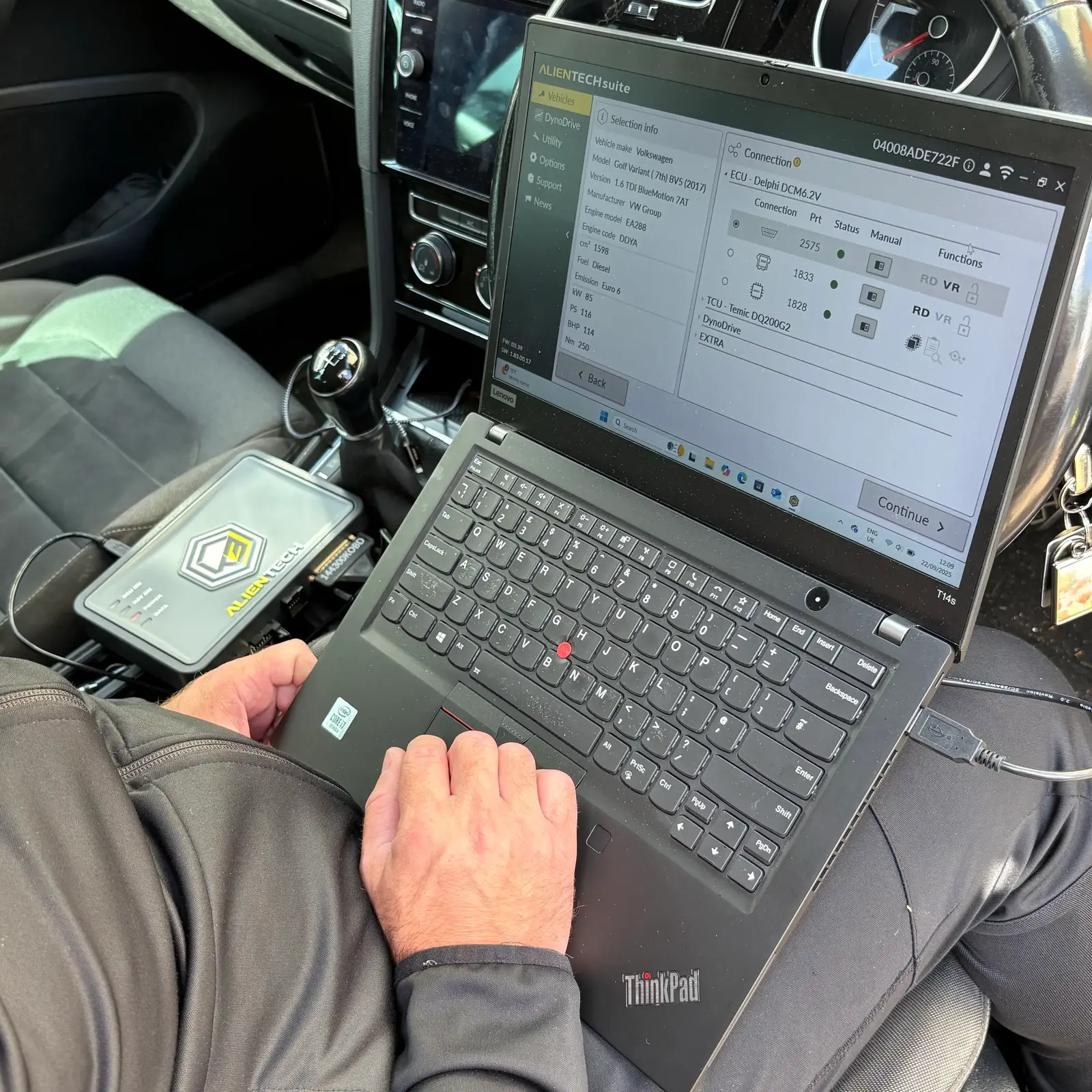
Checks should be appropriate to the individual vehicle and may include a diagnostic scan, a review of live data, service-history checks and a road test. Where symptoms or findings point to a mechanical concern, further inspection or testing may be needed before deciding whether a remap is suitable.
Warning lights, poor starting, smoke, unusual noises, oil consumption, overheating or uneven running need attention first. Tuning is not a repair for an existing fault. If the engine is already struggling, changing its calibration before identifying the cause can make diagnosis harder and may increase the risk of further damage.
Our ECU remapping service in Kent starts with a vehicle-specific discussion and checks before we recommend a suitable approach. If the evidence says "not yet", honest advice is to address the fault before considering a remap.
03
High-Mileage Remap Risks: Clutch and Flywheel Wear
A remap can increase torque: the engine's pulling force. That extra load may reveal a clutch that is already close to its limit. Signs such as clutch slip under acceleration, judder or an unusually high bite point should be investigated before tuning.
A dual-mass flywheel can also become noisy or worn over time. Rattling, vibration or knocking may point to a problem that needs assessment. Increasing the load on a marginal clutch or flywheel can bring forward the need for repair, with an unwelcome bill and vehicle downtime as a result.
A remap cannot make worn components healthy again. If there are symptoms of clutch or flywheel wear, the sensible recommendation is to repair and reassess first.
04
Turbo, Injectors and DPF: Check Their Condition
On a turbocharged engine, boost leaks, actuator problems or a worn turbo can affect performance and reliability. A calibration that changes how the engine delivers power should not be used to mask those issues. Faults in injectors or the fuel system can also affect combustion and drivability, so relevant symptoms or diagnostic data should be investigated.
Diesel vehicles need particular attention to the condition of their emissions systems. A DPF that is loading excessively, struggling to regenerate or showing pressure-related faults needs proper diagnosis.
A physically blocked DPF requires repair, not software changes. Removing or defeating emissions equipment can cause an MOT failure. A remap must not be treated as a way to bypass a DPF fault or avoid necessary repairs.
05
Service History: Check Timing Belt and Maintenance
Service records help show whether the vehicle has received the maintenance needed to stay in good working order. For cars with a timing belt, check its replacement history against the manufacturer's requirements. If the records are missing or the belt's condition is uncertain, resolve that uncertainty before tuning.
Oil, filters, cooling-system maintenance and previous repairs also matter. A remap does not replace routine servicing. Systems therefore need to be maintained properly after the work, just as they did before it.
Where a belt replacement or another scheduled maintenance item is overdue, deal with it first. The same applies to oil leaks, coolant loss or evidence of overheating: investigate the cause rather than adding load and hoping for the best.
06
High-Mileage Remap Benefits: Responsiveness and Economy
When a higher-mileage vehicle is in good condition, a suitable calibration can still offer useful real-world benefits. Depending on the vehicle and the chosen remap, drivers may notice more accessible torque, sharper throttle response and less need to change down during everyday driving.
An economy-focused calibration may also help the engine work more efficiently in normal use. A meaningful improvement in fuel use can be a realistic aim in suitable circumstances, but this is not guaranteed. The result depends on the vehicle, its condition, the journey and the driver's habits. A change in driving style can reduce or remove any potential saving.
For everyday drivers, the priority may be smoother response and a better driving experience. For a tradesperson, more usable torque or improved efficiency may matter more. Those aims involve different trade-offs between power and economy, so the calibration should reflect the vehicle and how it is used, not a generic promise.
07
When Is the Answer "Not Yet"?
Kent Eco Tuning may advise against proceeding until a known concern has been addressed. That could mean investigating clutch slip, checking a noisy flywheel, repairing a boost leak, resolving an injector fault, reviewing the DPF condition or confirming timing-belt history. This is not the same as saying that every high-mileage car is unsuitable. It means the risk should be understood before tuning. The vehicle health and safety information explains why the underlying condition matters. A remap can change how the engine responds, but it cannot restore worn hardware or guarantee that an ageing component will not fail. There is also no single calibration that suits every vehicle. A more power-focused option places different demands on the vehicle than an economy-led approach. The right choice depends on condition, intended use and the driver's priorities.
08
Is Remapping a High-Mileage Car Safe?
It can be suitable when the vehicle is healthy, properly maintained and assessed before tuning. High mileage alone does not rule it out. But if there are unresolved faults or components showing signs of wear, fixing those issues first is usually the more responsible choice. A health check reduces uncertainty; it does not guarantee that a vehicle will be trouble-free. A remap is not a substitute for mechanical repairs, servicing or manufacturer-specified maintenance. For advice on your vehicle, use the Kent Eco Tuning contact form or call 07946 854971. Visit www.kentecotuning.co.uk to learn more.